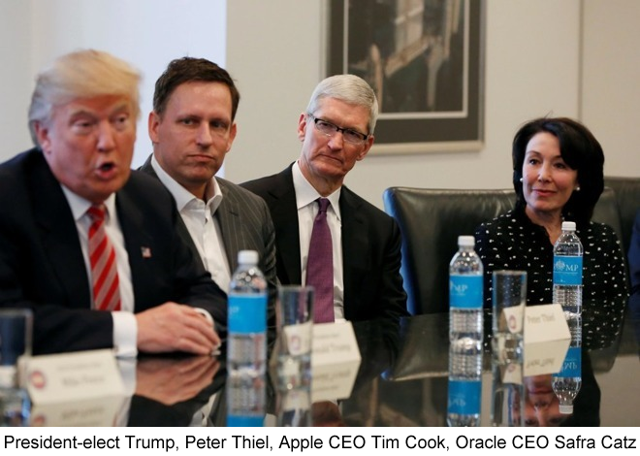
In an interview with the New York Times, venture capitalist Peter Thiel affirmed that "The age of Apple is over." He went on to say that there would be no more innovation in smartphones. Thiel is wrong about Apple (NASDAQ:AAPL) and mobile device technology.
 Click to enlarge
Source: AppleInsider
Pearls of Thiel Wisdom
I think it's worth noting that the interview appeared not in the Technology or Business sections of the Times, but in the Fashion section. Before I dig into his assertions about Apple, let me offer the reader a few other Thielisms from the interview. The interview was performed as a series of assertions by Maureen Dowd that Thiel either confirmed or denied:
California should secede.
Confirm. I'd be fine with that. I think it would be good for California, good for the rest of the country. It would help Mr. Trump's re-election campaign.
You like "Star Trek" more than "Star Wars."
Deny. I like "Star Wars" way better. I'm a capitalist. "Star Wars" is the capitalist show. "Star Trek" is the communist one. There is no money in "Star Trek" because you just have the transporter machine that can make anything you need. The whole plot of "Star Wars" starts with Han Solo having this debt that he owes and so the plot in "Star Wars" is driven by money.
Facebook is a media company.
I think the official policy is to deny that.
The age of Apple is over.
Confirm. We know what a smartphone looks like and does. It's not the fault of Tim Cook, but it's not an area where there will be any more innovation.
You think the stock market is a giant bubble right now.
Confirm.
It's not that I'm in complete disagreement with Thiel on all issues. I share his preference for Star Wars over Star Trek, although I wouldn't characterize Star Trek as "communist". As for California seceding, well, it might be good for California, but it probably wouldn't be good for the rest of the country. California contributes about 13.5% of the total GDP of the US, and as a separate country would rank seventh in the world.
Smartphone Innovation
Having observed and reported on the frenetic pace of mobile device innovation for a few years now, I think Thiel's assertion regarding smartphones is specious on its face. Smartphones continue to be a key area of innovation in microprocessor technology, cellular communications, display screens and battery technology.
Apple is probably the most important innovator in ARM processors for smartphones of any company on the planet. The company's problem has been and continues to be leveraging that innovation for market advantage. Each new iPhone release features an all-new ARM architecture processor that is the fastest in the industry (at least at the time of launch).
But the functionality of the phone, as governed by iOS, has not changed that much for the past couple of iterations. It's not necessarily apparent to consumers that AAPL's faster processor confers an advantage compared to competing smartphones, and the tech media roundly ignore Apple processors when dismissing iPhone as non-innovative.
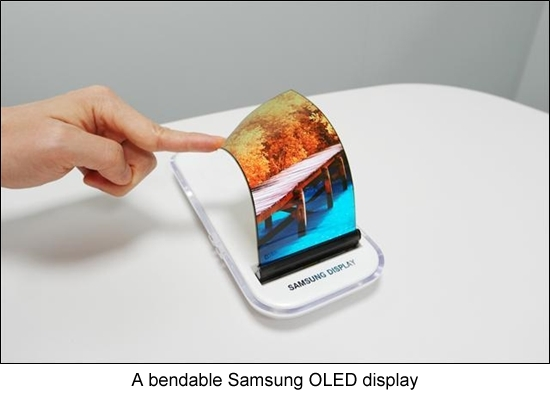
There are other areas of smartphone innovation pursued by other companies besides Apple. The development of OLED screens has been a significant innovation pursued mainly by Korean giants Samsung (OTC:SSNLF) and LG (OTC:LGEAF). It is now being reported that Samsung and LG will introduce smartphones with foldable OLED screens this year.
Bendable or foldable displays have long been an active area of research. It's really an exciting and innovative development, and I hope the reports are correct.
Source: Korea Herald
The fact that this innovation isn't coming from Apple shouldn't obscure the fact of the innovation. Apple is also innovating in another and perhaps more important way, by developing new form factors that may eventually serve to supplant the smartphone.
These form factors include Apple Watch, and possibly smartglasses such as those by Osterhout Design Group that I recently profiled. Moore's law is alive and well, especially in the mobile device world, and the advent of 10 nm process nodes from Samsung and TSMC (NYSE:TSM) will enable even smaller and more compact devices. This has been the general trend in consumer electronics for some time.
Another way to exploit the increasing power of mobile device processors is to allow them to function in more traditional computing roles. Microsoft (NASDAQ:MSFT) continues to explore this with the Qualcomm (NASDAQ:QCOM) powered mobile devices that were recently announced. Microsoft conceives of these devices (tablets, initially) as cellular PCs that could serve as desktop replacements.
In my article on the iPhone's 10-year anniversary, I pointed out that Apple could easily enable desktop usage of iOS devices (both iPad and iPhone) by providing for cursor support through an external trackpad or mouse. iOS devices can already connect to external monitors. This capability remains unexploited, however.
In sum, smartphone innovation hasn't ground to a halt. It continues to snowball, driven by intense competition in the mobile device industry. Thiel, of all people, should appreciate this, since this is exactly what free markets should do.
The New Age
It struck me as a little odd even to assert an "Age of Apple" let alone that it's over. For the most part, we're still in the Age of Wintel. Wintel computers remain the standard for most business and personal use. And if numbers of smartphones are important, one might as well call it the Age of Android.
Despite numerous signs of decline, one doesn't often hear pundits declaring the end of the Age of Wintel. But in fact, we are entering a New Age, and it's an era in which Windows is no longer the dominant computing platform. I've called this the Tripartite World, because it is shared by Alphabet's (NASDAQ:GOOG) (NASDAQ:GOOGL) Android and Apple's OS X derived platforms.
Far from the decline that Thiel seems to contemplate, I see Apple continuing to grow into an equal competitor in the Tripartite World. Indeed, if market capitalization and earnings are any indication, Apple could well become dominant, giving rise to a new Age of Apple.
It's clear that many of AAPL's competitors fear exactly that, and I think this is why media coverage of Apple and its products is so relentlessly negative. In fact, Apple's competitors have less to fear from an Age of Apple than Microsoft's competitors had to fear from the Age of Wintel.
Apple possesses none of Microsoft's (or Intel's (NASDAQ:INTC)) predatory competitiveness. Apple doesn't seek domination of the world, as Wintel did. Apple doesn't need to utterly crush its adversaries. The Age of Apple would be far less oppressive than the Age of Wintel.
Ultimately, Apple truly is motivated by the simple desire to build great products. Not to make the most money, or force everyone to use its products exclusively. In the Age of Apple, there would be far more variety and consumer choice, including Windows and Android.
Investor Takeaway
I'm an Apple investor. That doesn't mean I think Apple is perfect. It's not. Its management can and does make mistakes. If I wanted a perfect company as an investment, I wouldn't have any investments.
Despite its imperfections, I still consider Apple an excellent investment in the long term, and it remains a key holding of my portfolio, as I make clear in the DIY Investing Summit.* Apple has the most profitable computing platform on the planet in its iOS devices. It has world-class ARM processor design expertise that it continues to leverage into new products such as Apple Watch and the wireless Air Pods. Apple's various operating systems share a rock-solid foundation in OS X. Apple has proven that its ability to integrate hardware and software is the best in the consumer electronics industry.
So when I criticize Apple, it's only because I want it to be better, to achieve more, and most importantly, to start growing again. It's what most Apple investors want and still hope for, and no apologies for wanting that need be offered.
Apple's enormous profitability affords it multiple pathways to growth, and in calendar 2017, we will see a number of catalysts for growth. These include new A11 series processors fabricated on TSMC's 10 nm node, a 10th anniversary iPhone, refreshed iPads, an all-new Apple Watch, and new desktop Macs. I remain long Apple and recommend it as a buy for investors with a 3-5 year investment horizon.
*The DIY Investing Summit is a joint project of Seeking Alpha and SA Contributor Brian Bain. The Summit brings together 25 of the top SA contributors, including myself, for in-depth interviews with tips for successful investing in 2017. Normally, the Summit requires a fee, but you can get free access by clicking on the link here.
This is a limited time offer, so please don't wait too long to listen to your favorite SA contributors on the Summit. Thanks for reading, and good luck in the new year!
Disclosure: I am/we are long AAPL.
I wrote this article myself, and it expresses my own opinions. I am not receiving compensation for it (other than from Seeking Alpha). I have no business relationship with any company whose stock is mentioned in this article.
Editor's Note: This article discusses one or more securities that do not trade on a major U.S. exchange. Please be aware of the risks associated with these stocks.
Source: Why Peter Thiel Is Wrong About Apple

No comments:
Post a Comment